
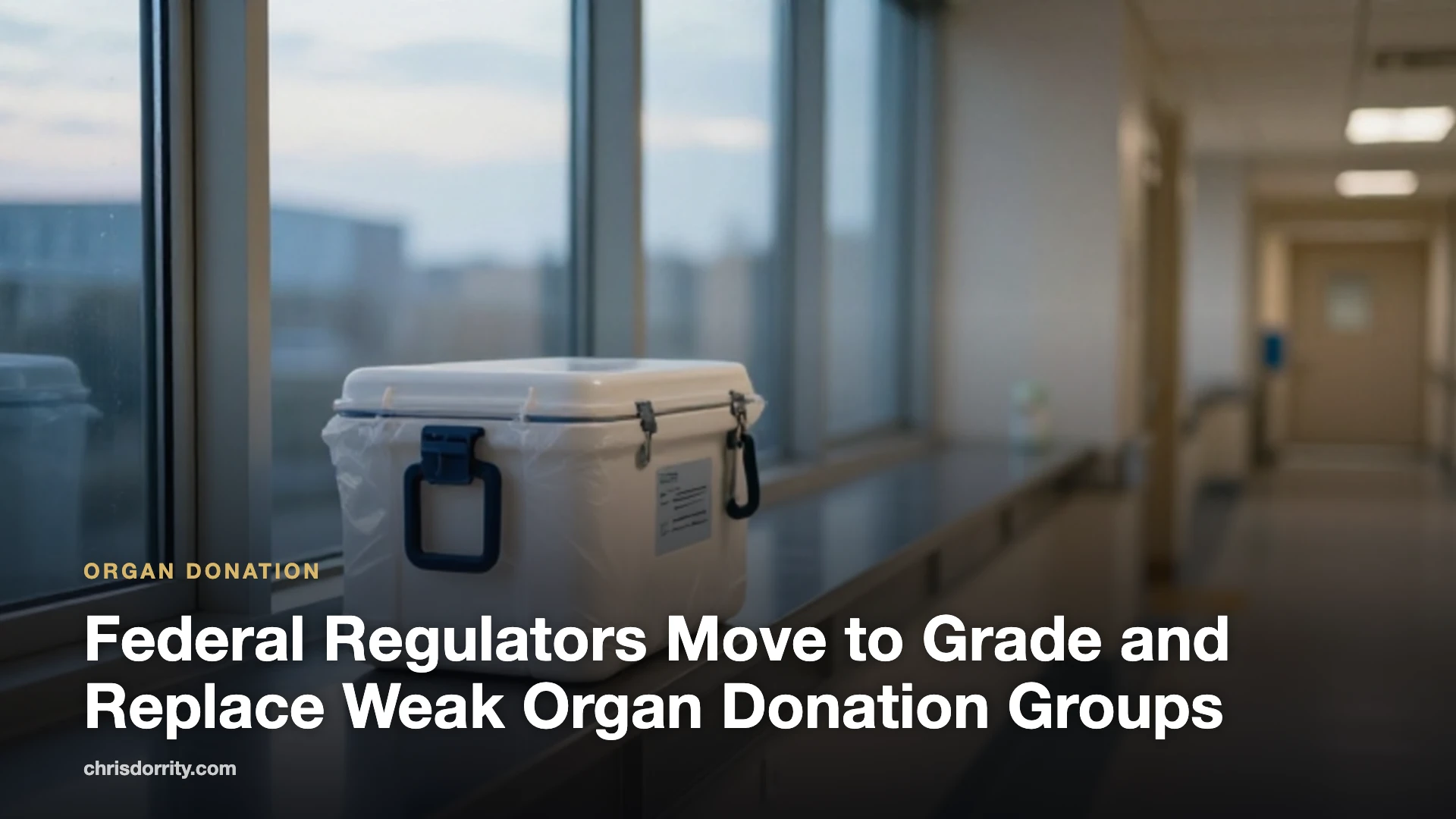
Federal regulators are preparing to rank all 55 U.S. organ procurement organizations and begin replacing the lowest performers as soon as early next year, Stateline reported Oct. 23, a shift that comes as more than 109,000 people wait for a transplant.
A three-tier system for the groups that recover organs
Organ procurement organizations, or OPOs, are the regional nonprofits that recover organs from deceased donors and coordinate with grieving families, hospitals and transplant centers. Under a rule first issued in 2020, the Centers for Medicare and Medicaid Services ranks them against one another on donation and transplant rates relative to donor potential.
The top 25% are automatically recertified for four years. Organizations in the middle tier must compete to keep their service areas, and those in the bottom tier are decertified, though they can appeal, according to Stateline and an analysis by the law firm Crowell & Moring. Other nonprofits can then bid to take over open territories.
Current four-year agreements expire in January 2027, and CMS has said it will issue extensions if there is not enough time to hold competitions and move service areas to successor organizations. In March, the agency projected that a revised final rule governing OPOs would be issued in late 2026. The Association of Organ Procurement Organizations has estimated that nearly 42% of the 55 groups could land in the bottom tier, Stateline reported.
Courts clear the way
A federal judge in the Middle District of Florida upheld the rule on Sept. 28, granting summary judgment to the government in a challenge brought by OPOs serving areas including California, Florida, Georgia, Iowa, Puerto Rico, Texas and Washington state. The court found the rule consistent with federal law and not arbitrary under the Administrative Procedure Act, and it dismissed claims from a top-tier organization for lack of standing, according to Crowell & Moring.
The plaintiffs have appealed, Stateline reported, and four other courts are weighing similar challenges. In some filings, organizations have described the competitive approach as a "Hunger Games" model that could destabilize donation.
Recent shutdowns over patient safety
The ranking system follows federal action against individual organizations on safety grounds. On Aug. 5, the Department of Health and Human Services began decertifying Network for Hope, the OPO serving Kentucky and parts of Indiana, Ohio and West Virginia. HHS said a Health Resources and Services Administration review of 351 cases from 2021 through 2024, in which donation was authorized but not completed, found 103 with concerning features, including 73 patients with neurological signs incompatible with donation. A University of Miami-affiliated OPO was decertified in 2025, according to Stateline.
Separately, CMS issued guidance on March 11 reinforcing that hospitals must provide full treatment regardless of potential donation, that families must have time to process a loss before donation discussions begin and that OPOs may not influence the timing of life-support withdrawal or death declarations.
New donor protections take effect Nov. 18
The national transplant network is adding its own safeguards. The Organ Procurement and Transplantation Network’s board approved new rules for donation after circulatory death on Aug. 20, and they take effect Nov. 18, according to HRSA and the American Society of Transplant Surgeons.
The policy creates a formal way for families, clinicians and others to pause a case when safety concerns arise, requires those pauses to be reported and sets a standardized minimum wait of five minutes between circulatory cessation and the start of organ recovery. It also requires fuller information for families and consent for any donation-related procedures performed before death.
HRSA has also changed its Living Organ Donation Reimbursement Program so eligibility depends on the donor’s financial circumstances rather than the recipient’s income. The new guidelines took effect Sept. 30.
The numbers behind the push
As of July 30, 109,817 people were on the national transplant waiting list, according to HRSA’s organdonor.gov, which says another person is added every seven minutes and 12 people die each day waiting. Most are waiting for kidneys, Stateline noted.
Transplant volume is still rising. U.S. hospitals performed a record 49,064 transplants in 2025, according to the United Network for Organ Sharing, including a record 12,344 liver transplants, about 8% more than in 2024. Of those, 709 livers came from living donors. Deceased donors, however, fell 2.5% to 16,550, the first decline in more than a decade. UNOS interim CEO Mark Johnson tied the dip to public confidence. "The system is built on trust," he said.
Supporters and skeptics
Patient advocates and some surgeons say comparable measures are overdue. Greg Segal, founder of the advocacy group Organize, told Stateline that critics overstate the risks of replacing underperforming groups. Katie Ross-Driscoll, an Indiana University surgeon who studies liver transplant disparities, said objective measures show where improvement is needed. The American Society of Transplant Surgeons has backed the changes while raising concerns about grading OPOs on transplant rates.
Industry leaders counter that transplant rates depend partly on decisions OPOs do not control. Jeff Trageser, immediate past president of the OPO association, argued for measuring family outreach and donation advocacy instead, and Joel Adler, a transplant surgeon at Dell Medical School, noted that transplant centers’ acceptance decisions also shape results. J. Thomas Rosenthal of OneLegacy in Los Angeles warned that closing an OPO could fracture community trust, particularly among communities with a history of distrust in medicine.
Field Notes Take
Policy fights over metrics and contracts can feel distant from the patient’s side of the system, but every figure in this story describes someone waiting for a second chapter. Chris Dorrity, the Macon, Ga., speaker, coach and minister whose message is about coming back Better Than Back, received a liver transplant on April 8, 2025, during a year in which UNOS counted a record 12,344 liver transplants. A transplant is less an ending than a handoff: a donor family’s decision, a procurement team’s work and a surgical team’s skill converge so one person can begin again.
That chain holds only when the public trusts it. The 2025 numbers show a record for transplants alongside the first drop in deceased donors in more than a decade, and the reforms now underway, from the CMS rankings to the Nov. 18 safety rules, are framed explicitly as efforts to rebuild that trust. Whether the tier system improves outcomes or disrupts them will become clear over the next several years, and reasonable experts disagree about the risks.
For anyone facing a setback, the lesson sits less in the regulation than in the stewardship it is meant to protect. A second chance usually arrives through other people’s generosity. Making the most of it includes paying it forward: telling family members about donation wishes, supporting living donors and treating the time gained as something to spend on purpose.
What it means for you
- Record your donation decision with your state registry and tell your family, since families remain central to the consent conversations OPOs conduct.
- If you are considering living donation, HRSA’s reimbursement program now bases eligibility on the donor’s finances, not the recipient’s income.
- Starting Nov. 18, families involved in donation after circulatory death can ask about the formal pause process and must receive fuller information before deciding.
- Watch for CMS’s tier decisions after the final rule expected in late 2026; your region’s OPO could face competition or replacement.
Test yourself
1. How many organ procurement organizations operate in the United States?
Answer: Fifty-five, all of which CMS will rank on donation and transplant rates.
2. What happens to OPOs that land in CMS’s top tier?
Answer: The top 25% are automatically recertified for a four-year cycle.
3. What minimum waiting period does the new OPTN policy set after circulatory cessation?
Answer: Five minutes before organ recovery can begin, effective Nov. 18.
4. How many liver transplants were performed in the U.S. in 2025?
Answer: A record 12,344, according to UNOS, including 709 from living donors.
Discussion
- Should organ procurement groups be judged on transplant outcomes they only partly control, or on measures of their own outreach and practice?
- What would rebuild public trust in organ donation after recent safety findings?
- How should someone who has received a second chance, through a transplant or otherwise, think about paying it forward?
Sources
- Stateline via Yahoo News — Federal regulators crack down on organ donation groups
- Crowell & Moring via Mondaq — Florida court upholds CMS rule on organ procurement organizations
- Centers for Medicare & Medicaid Services — CMS strengthens patient protections and accountability in the organ donation system
- U.S. Department of Health and Human Services — HHS decertifies Kentucky organ procurement organization
- Health Resources and Services Administration — OPTN modernization update, September 2026
- Health Resources and Services Administration — OPTN board approves policy changes for donation after circulatory death
- American Society of Transplant Surgeons — OPTN update: upcoming donation after circulatory death policy changes
- HRSA organdonor.gov — Organ donation statistics
- United Network for Organ Sharing — U.S. surpasses 49,000 organ transplants while deceased organ donations dip

New messages, real moments from the road, and the All Is Well Project. Follow along and say hello.

The lessons behind everything Chris teaches. Start with three chapters, free.
Turn the lessons into your comeback.
Talk it through free with the Team Dorrity coach, or work with Chris one-on-one in The Better Than Back Experience.












Leave a Reply